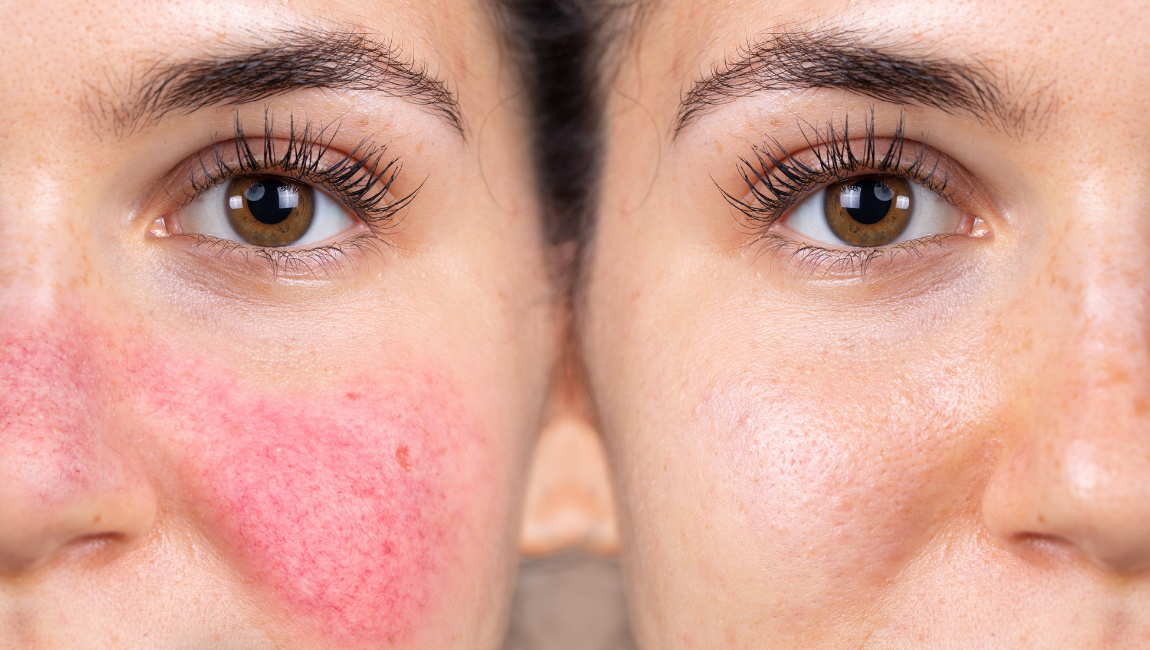
Close-up comparison of facial skin showing rosacea-related redness and inflammation on one cheek compared with calmer, more even-toned skin, illustrating the potential benefits of azelaic acid for redness and sensitive skin.
Could one skincare ingredient help with both redness and breakouts? If your skin is easily irritated, prone to flushing or persistent redness, but you also struggle with spots, congestion or adult acne, azelaic acid is an ingredient worth knowing about.
Unlike some traditional acne treatments that can leave skin feeling dry, tight and irritated, azelaic acid has both anti-inflammatory and antibacterial properties. This makes it particularly interesting for people who experience a combination of sensitive, reactive skin and acne.
At Fresh Aesthetics & Skin, we believe good skincare starts with understanding what your skin actually needs. Let's look at what azelaic acid does, the different strengths available and whether it could be a useful addition to your skincare routine.
What Is Azelaic Acid?
Azelaic acid is a naturally occurring dicarboxylic acid found in grains such as wheat, rye and barley. It is also produced naturally by microorganisms that live on the skin.
In skincare, it is valued for its ability to target several different skin concerns without relying on aggressive exfoliation.
Azelaic acid has four particularly useful properties:
Anti-inflammatory: Helps calm inflammation, making it useful for skin prone to redness, irritation and inflammatory breakouts.
Antibacterial: Helps reduce the activity of acne-associated bacteria within the hair follicles.
Comedolytic: Helps normalise the build-up of skin cells within pores, reducing congestion and the formation of spots.
Pigmentation regulating: Helps regulate tyrosinase, an enzyme involved in melanin production, making it useful for reducing post-inflammatory pigmentation left behind after spots.
What makes azelaic acid particularly interesting is that it addresses both inflammation and congestion. Rather than simply drying out spots, it works through several different mechanisms to improve the overall condition of the skin.
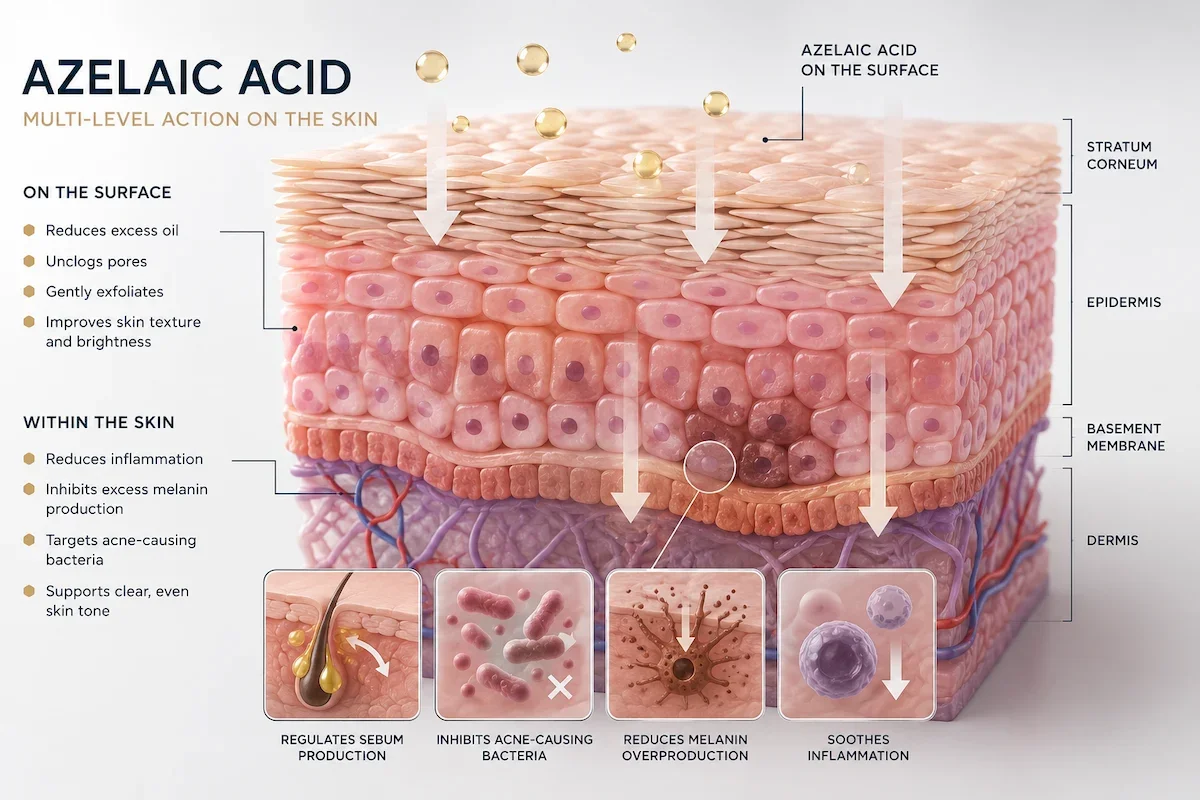
Medical illustration showing how azelaic acid works on multiple layers of the skin to reduce inflammation, regulate oil production, unclog pores, target acne-causing bacteria, reduce excess pigmentation and improve skin texture and redness.
Why Is Azelaic Acid Particularly Good for Redness, Reactive Skin & Acne?
Many people experience what feels like contradictory skin problems. Their skin is sensitive, easily flushed and prone to redness, yet they also experience blocked pores, small bumps, inflamed spots or persistent adult acne.
Using conventional acne products can sometimes make matters worse. Strong exfoliating acids, benzoyl peroxide and retinoids can cause irritation, particularly when the skin barrier is already compromised.
Azelaic acid offers an alternative approach because of its anti-inflammatory properties.
1. Helps calm redness and rosacea-prone skin
Azelaic acid is an established topical treatment for papulopustular rosacea, a type of rosacea characterised by persistent inflammatory bumps and pustules, often accompanied by facial redness.
It helps reduce inflammatory activity in the skin and can improve the number of inflammatory lesions as well as the overall appearance of affected areas.
It is important to understand that rosacea is a chronic inflammatory skin condition. Azelaic acid can help manage its symptoms, but it does not cure rosacea or necessarily eliminate persistent background redness and visible blood vessels.
2. Helps manage adult acne and breakouts
Azelaic acid works on several processes involved in acne formation.
It helps reduce acne-associated bacteria, normalises the shedding of skin cells within pores and reduces inflammation around existing spots.
This makes it useful for people experiencing:
Inflamed spots and papules.
Whiteheads and blackheads.
Congested skin and blocked pores.
Hormonal or adult acne.
Breakouts accompanied by redness and sensitivity.
It can be particularly useful when someone struggles to tolerate more aggressive acne treatments.
3. Helps improve post-acne pigmentation
Have you noticed that even after a spot has disappeared, a red or brown mark remains?
These marks are known as post-inflammatory changes. Brown marks are caused by increased pigmentation following inflammation, while red marks are associated with residual vascular changes.
Azelaic acid can help with the pigmentation component by regulating melanin production. It is particularly useful for brown post-acne marks, although it will not directly remove every type of red acne mark.
With consistent use, skin tone can become more even.
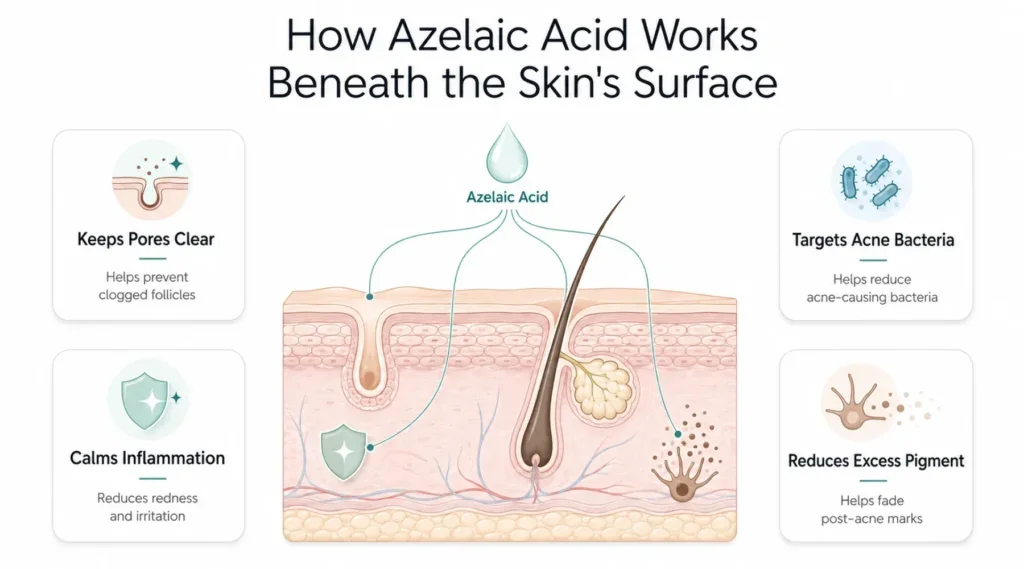
Diagram showing how azelaic acid works beneath the skin's surface: keeps pores clear, targets acne bacteria, calms inflammation and reduces excess pigment
What Strengths of Azelaic Acid Are Available?
Azelaic acid is available in different concentrations, ranging from cosmetic skincare products to prescription-strength preparations.
The concentration matters, but so does the formulation. A 15% gel and a 20% cream can behave differently on the skin, and a higher percentage does not automatically mean better results for everyone.
10% Azelaic Acid
Often found in over-the-counter skincare products.
A 10% formulation may be a useful starting point for someone looking to introduce azelaic acid into their routine, particularly if they have mild congestion, uneven skin tone or occasional inflammatory breakouts.
However, cosmetic formulations vary considerably in their delivery systems and supporting ingredients. Not all 10% products will perform in the same way.
15% Azelaic Acid
A clinically established concentration, particularly for inflammatory rosacea.
Finacea is a prescription-strength 15% azelaic acid gel used in the UK for papulopustular rosacea. It is also licensed for mild to moderate papulopustular acne in the facial area.
This concentration has good clinical evidence for reducing inflammatory bumps, pustules and associated redness.
For someone experiencing both redness and acne-like breakouts, 15% azelaic acid may be an especially useful option following appropriate assessment.
20% Azelaic Acid
Skinoren is a prescription-strength 20% azelaic acid cream licensed for the treatment of acne vulgaris.
It works through similar mechanisms to the 15% preparation, helping to reduce acne-associated bacteria, normalise pore function and calm inflammation.
The cream formulation may suit some patients better than a gel, although individual tolerability varies.
Is 20% better than 15%?
Not necessarily. The best strength depends on the skin concern, formulation, skin sensitivity and individual response. A 15% preparation may be more appropriate for someone with papulopustular rosacea, while a 20% preparation may be selected for acne.
The aim is not to use the strongest product possible. It is to find the formulation that delivers results without unnecessarily irritating the skin.
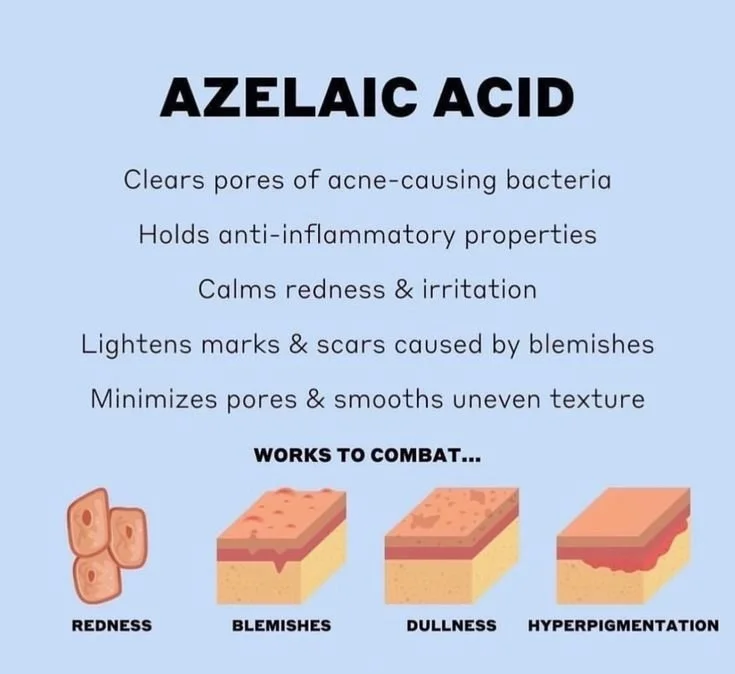
Infographic listing azelaic acid benefits: clears acne-causing bacteria, calms redness and irritation, lightens post-blemish marks and smooths texture, and combats redness, blemishes, dullness and hyperpigmentation
Who Would Benefit Most From Azelaic Acid?
Azelaic acid may be particularly suitable if you:
Have sensitive skin that becomes red or irritated easily.
Experience facial redness alongside breakouts.
Have rosacea-prone skin with inflammatory bumps and pustules.
Struggle with adult acne but find traditional acne treatments too harsh.
Have congested skin, blackheads or blocked pores.
Are left with brown marks after spots have healed.
Want an ingredient that targets inflammation as well as acne.
It is also worth considering for people who want to improve several aspects of their skin without introducing multiple aggressive active ingredients.
However, not all redness is the same. Persistent flushing, visible blood vessels, dermatitis and an impaired skin barrier have different causes and may require different treatment approaches.
A proper skin assessment is important before choosing an active ingredient.
How Do You Introduce Azelaic Acid Into Your Skincare Routine?
Although azelaic acid is generally well tolerated, it is still an active ingredient. Sensitive skin needs a considered approach.
We recommend introducing it gradually rather than immediately using it every day.
A simple approach:
Start with a lower-strength formulation or follow the instructions provided for your prescribed preparation.
Apply to clean, dry skin, initially on alternate evenings if appropriate.
Use a moisturiser to support the skin barrier.
Increase frequency gradually as your skin becomes accustomed to it.
Apply broad-spectrum SPF 30–50 every morning.
Some people experience mild tingling, itching, dryness or temporary stinging when first introducing azelaic acid. This does not necessarily mean it is unsuitable, but persistent or significant irritation should not be ignored.
If your skin is already very inflamed, irritated or compromised, it may be better to focus on restoring your skin barrier before introducing another active ingredient.
Be mindful of combining azelaic acid with other potentially irritating ingredients, particularly strong exfoliating acids, retinoids and benzoyl peroxide. They are not necessarily incompatible, but introducing several actives together can make it difficult to identify the cause of irritation.
How Long Does Azelaic Acid Take to Work?
Azelaic acid is not an overnight treatment. Consistency is important.
Some people notice early improvements in acne within four weeks, while more significant improvements can take 8–12 weeks or longer.
For rosacea, clinical improvements are commonly assessed over approximately 12 weeks.
Pigmentation can take several months to improve, particularly when marks are deeper or more persistent.
The important thing is to give the ingredient sufficient time while monitoring how your skin responds.
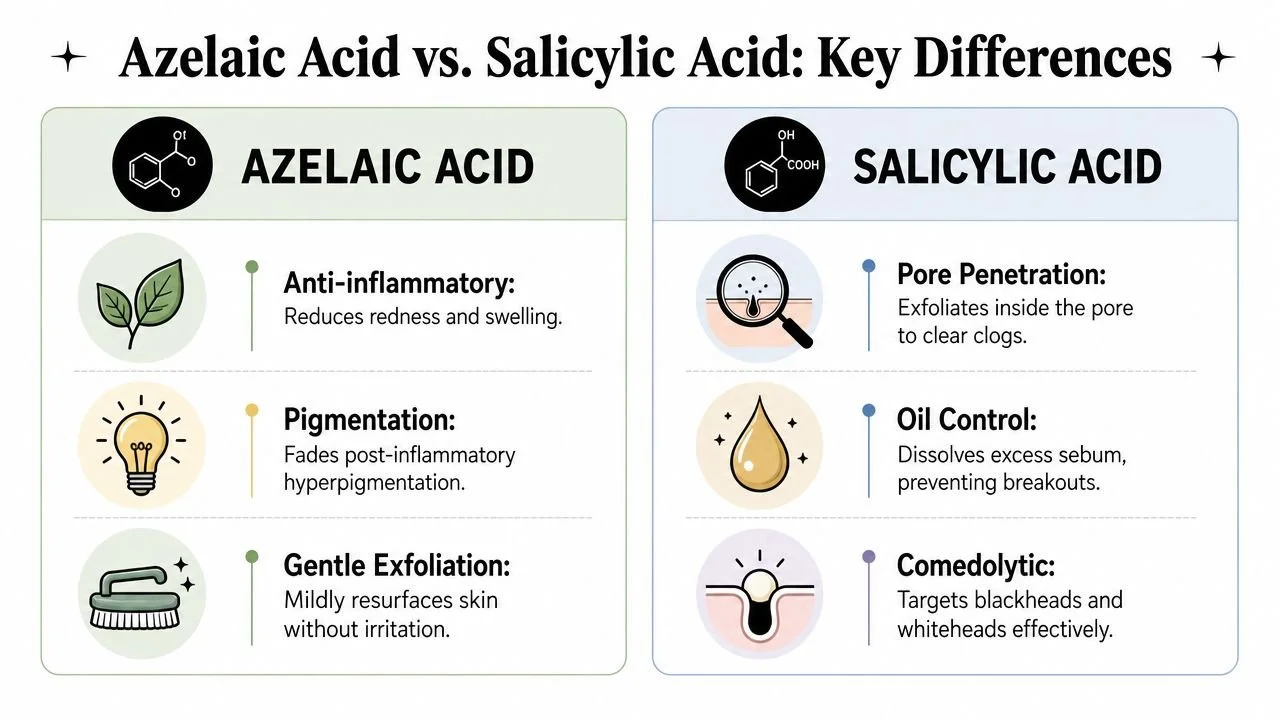
Comparison infographic of azelaic acid vs salicylic acid: azelaic acid calms inflammation and fades post-inflammatory pigmentation, while salicylic acid exfoliates inside pores, controls oil and targets blackheads and whiteheads
Is Azelaic Acid Better Than Niacinamide or Salicylic Acid?
These ingredients are often discussed together, but they have different roles.
Azelaic acid is particularly useful when inflammation, redness and acne occur together. It has antibacterial, anti-inflammatory and pigmentation-regulating properties.
Niacinamide supports the skin barrier, helps regulate oil production and can improve uneven skin tone. It is often a useful supporting ingredient for sensitive skin.
Salicylic acid is oil-soluble, allowing it to penetrate into pores and help clear congestion. It can be useful for blackheads and oily acne-prone skin, although it may be irritating for some people with reactive skin.
There is no single best ingredient for everyone. The right choice depends on what is happening within your skin and how well it tolerates active ingredients.
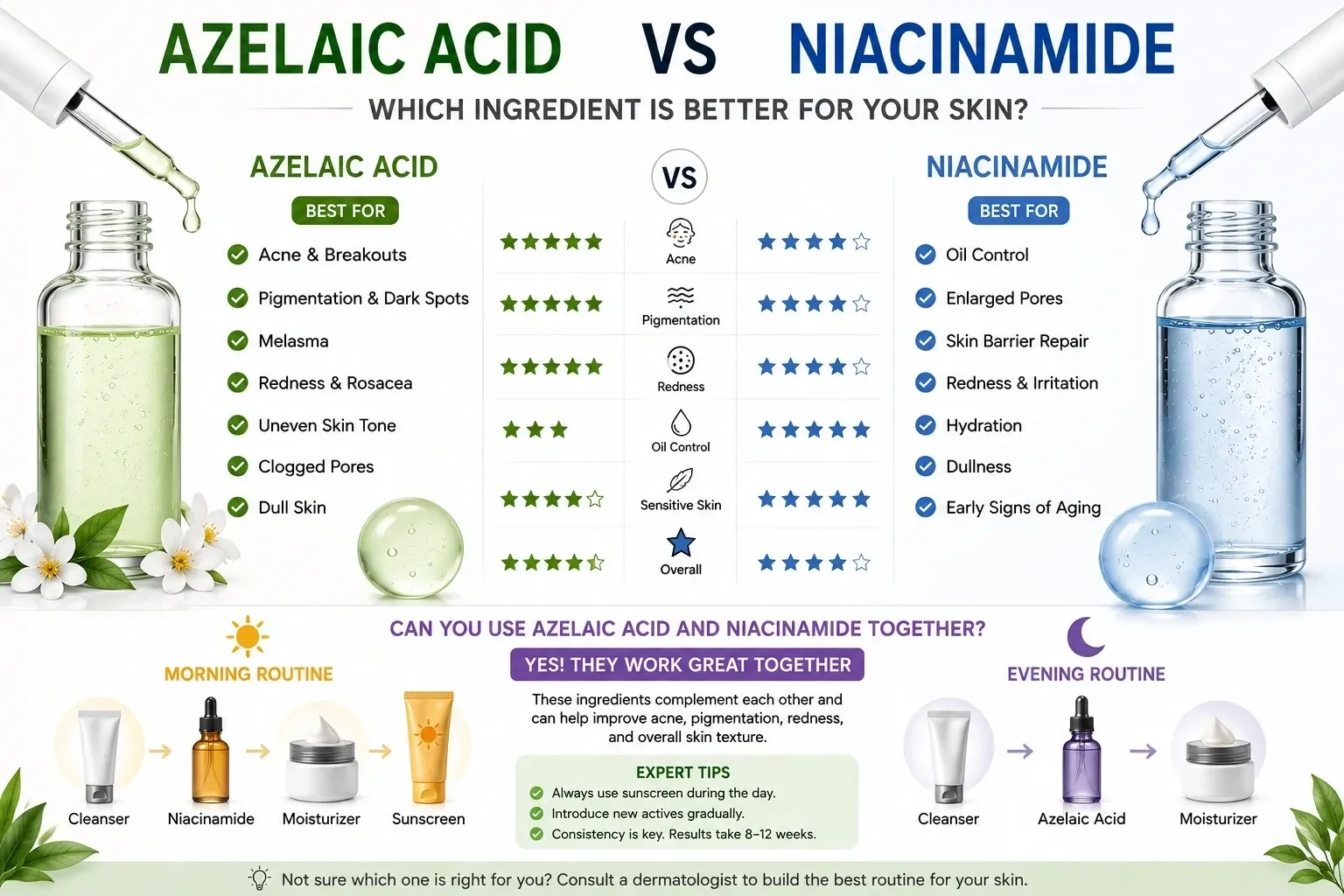
Comparison infographic of azelaic acid vs niacinamide: azelaic acid is best for acne, pigmentation and redness, niacinamide for oil control, pores and barrier repair, with a suggested morning and evening routine using both
Our Approach to Managing Redness and Acne at Fresh Aesthetics & Skin
At Fresh Aesthetics & Skin, we believe that treating skin successfully is about more than simply selecting a product with the highest percentage of active ingredients.
If you have redness, sensitivity and acne, we want to understand why these problems are occurring together.
Is your skin barrier compromised? Is there an underlying inflammatory condition such as rosacea? Are you experiencing hormonal acne, congestion or a combination of several concerns?
These distinctions matter because the treatment approach will be different.
Sometimes the best starting point is simplifying your skincare routine, supporting barrier function and reducing inflammation before introducing stronger active ingredients.
Medical-grade skincare can play an important role in improving skin health, but it needs to be selected according to your individual skin condition, rather than following trends or copying someone else's routine.
Our aim is always healthier, more resilient skin that functions well, not simply skin that looks good for a few days.
If you are struggling with persistent redness, reactive skin or adult acne, a professional skin consultation can help identify the most appropriate approach.
Healthy skin starts with understanding your skin.
At Fresh Aesthetics & Skin, Portadown, we are here to help you make informed choices about your skin health.
Frequently Asked Questions About Azelaic Acid
Can azelaic acid help with both acne and rosacea?
Yes. Azelaic acid has anti-inflammatory and antibacterial properties and is used to treat acne vulgaris and papulopustular rosacea. It can be particularly useful for people who experience inflammatory breakouts alongside facial redness.
Is azelaic acid suitable for sensitive skin?
It is generally well tolerated and may be a useful option for sensitive, redness-prone skin. However, it can still cause stinging, burning or irritation, particularly if the skin barrier is compromised. Introduce it gradually and seek professional advice if irritation persists.
What percentage of azelaic acid is best for rosacea?
Prescription-strength 15% azelaic acid gel (Finacea) is an established treatment for papulopustular rosacea. The appropriate preparation depends on the type and severity of rosacea and individual skin tolerance.
Is 20% azelaic acid too strong for sensitive skin?
Not necessarily, but a higher concentration may increase the risk of irritation. The 20% cream is a prescription treatment for acne, and it may not be the best starting point for someone with highly reactive skin. However, Skinoren, the 20% preparation is cream based, so may therefore be more suitable for dry skin.
Can I use azelaic acid every day?
Many people can use it daily once their skin has adjusted. However, frequency should depend on the product, concentration and individual tolerance. Follow the directions for your particular preparation.
Does azelaic acid cause skin purging?
Azelaic acid is not generally associated with the pronounced purging sometimes seen with stronger cell-turnover ingredients. However, temporary irritation or an increase in visible breakouts can occur. Persistent worsening should be assessed rather than assumed to be purging.
Can I use azelaic acid with retinol?
They can be used within the same skincare routine, but introducing both simultaneously may increase irritation, particularly in sensitive skin. It is often better to introduce one active ingredient at a time and establish tolerance before combining them.
Does azelaic acid help with redness from rosacea?
Yes. Clinical research supports its